
Wedding Guest Dresses UK: How to Pick One for Any Dress Code
Choosing from the wedding guest dresses UK shops have on offer is far easier once you’ve decoded the invitation. Start with the dress code, then the venue, the season and the time of day, and finally the couple’s wishes. Get those four right and almost any dress you love will work. The two rules that rarely change: don’t wear white or anything close to it, and don’t wear something that will make you miserable by the evening.
Below we go through each UK dress code you’re likely to see on an invitation, with what it means for a dress, plus practical tips on colour, hats, church ceremonies and seasons. We’ve drawn on guidance from Debrett’s, the long-standing British etiquette authority, and Bridebook, and added what we’ve learned from spending our working weekends at weddings with a camera in hand.
Wedding guest dresses UK: decoding the dress code
British invitations use a handful of dress codes. Here is what each one means when you’re choosing a dress.
Morning dress
This is the most traditional daytime code, usually for formal weddings and church ceremonies. Debrett’s suggests smart daywear, such as a dress or a skirt with a jacket, and says dresses should not be too short or too revealing. In summer a dress can be worn without a jacket, but it should be modest, with sleeves or at least not narrow straps. Debrett’s also says hats are usual, especially at weddings, but not always required, and recommends one that can stay on all day and is securely fitted. A tailored jacket or coat is better than a shrug for a smart wedding.
Black tie
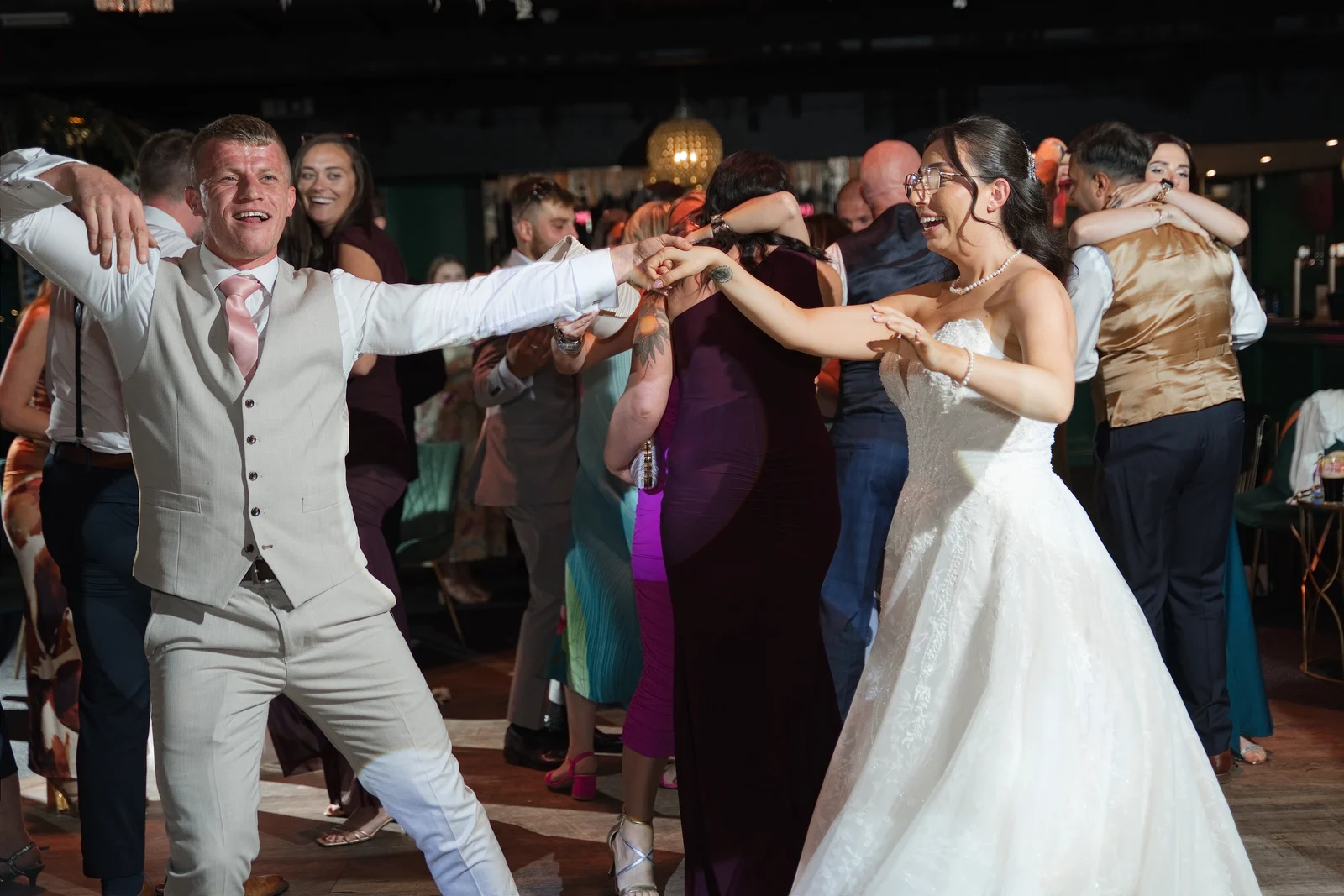
An evening code. Debrett’s says women should wear an evening dress or skirt, with evening trousers as an alternative, and that dresses don’t have to be black. It also advises avoiding very wide, full-skirted styles if there’s a dinner dance. Bridebook describes black tie for guests as an elegant evening gown or cocktail dress.
Lounge suit
Smart, but not as formal as morning dress. For daytime, Debrett’s suggests a day dress, a trouser suit or a skirt with a jacket or coat. For an evening event, a cocktail dress with sleeves or a jacket.
Formal
Bridebook describes this as a suit for men and a knee-length dress for women, ideally with covered shoulders. Think polished rather than glamorous.
Smart casual or semi-formal
The most common code, and the most confusing. Debrett’s says a smart day dress with a jacket is the safest choice. Bridebook suggests a midi dress, and warns that anything you wear should not look like everyday casual clothing. If there’s no dress code on the invitation at all, Bridebook’s advice is to dress semi-formal or smart casual.
Casual
Usually for relaxed garden, festival or beach-style weddings. Bridebook suggests a sundress or a blouse and skirt. Casual still means wedding casual, so save the denim for another day.
Not sure? Ask
If the invitation is vague, message the couple or a member of the wedding party. Nobody minds being asked, and it’s much better than guessing wrong. Wedding websites often answer it too.
Colours: what to avoid and what works
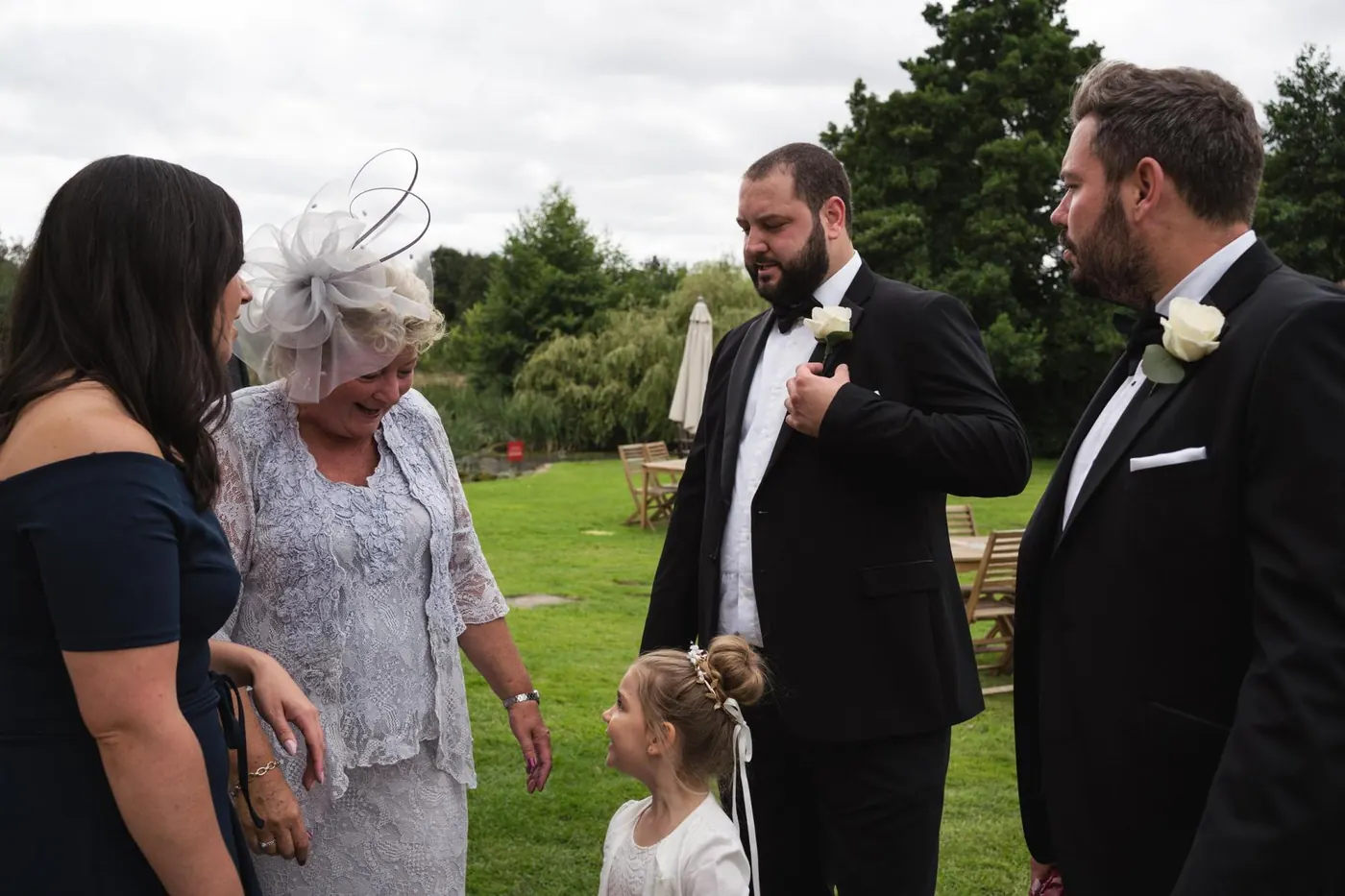
- Skip white and its cousins. Bridebook lists white, ivory, cream and taupe as colours to avoid so you don’t upstage the couple. In photos, pale champagne and light grey can read as white too, so be cautious with those.
- Check the wedding party colours. Bridebook suggests asking about the colours the bridal party are wearing, so you don’t accidentally match the bridesmaids.
- Black is a judgement call. Bridebook says some couples don’t mind black and others do, unless it’s black tie. It’s generally fine in winter, less so in spring and summer.
- Seasonal shades look natural. Pastels and florals suit summer; richer tones and fabrics such as velvet suit the colder months.
From behind the camera, we’d add that strong solid colours and bold prints look lovely in group photos. Very fine stripes or tiny checks can sometimes create a shimmering effect on screen in video, so if you’re choosing between two dresses for a filmed wedding, the plainer fabric is the safer bet.
Church and religious ceremonies
If the ceremony is in a church or another place of worship, check how modest you need to be. Bridebook suggests avoiding plunging necklines, backless styles, mini skirts, bandeau cuts and spaghetti straps for church, and notes that some religious venues require covered shoulders and knees, and sometimes covered hair or shoes removed. A pashmina, bolero or jacket over a strappy dress solves most of this for the ceremony, and you can take it off for the party.
Hats and fascinators
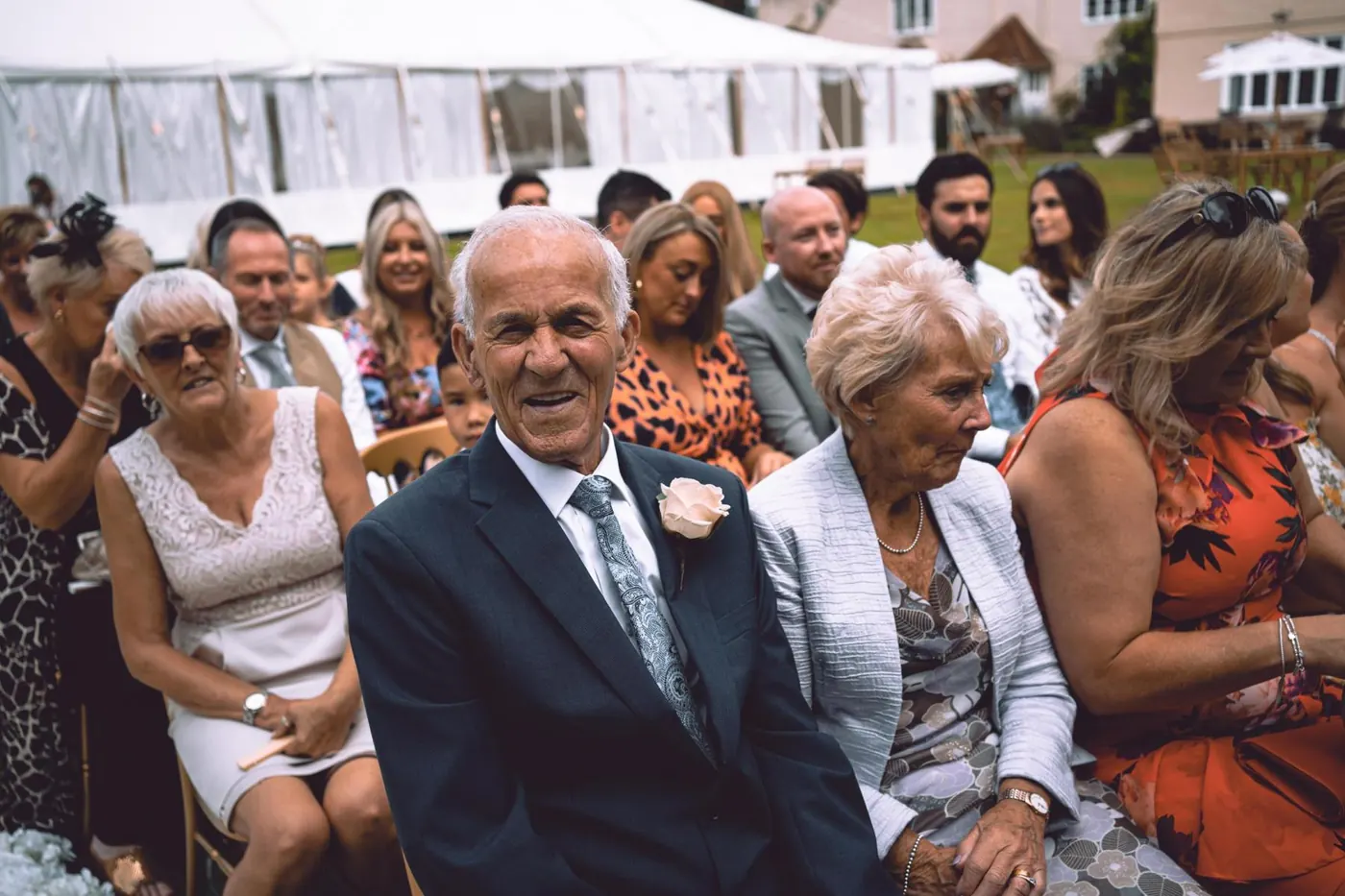
For a formal UK wedding, a hat or fascinator is traditional but not compulsory, as Debrett’s notes. Bridebook adds that hats are traditionally worn through the ceremony and wedding breakfast, then taken off for the evening, and that very large hats can block other guests in photos. As photographers, we’d back that up: a wide brim can hide your face in the group shots, and at a seated ceremony it can block the view for the row behind. A neat hat or a smaller fascinator usually looks better in pictures.
Dressing for the season and the venue
Spring and summer
Breathable fabrics such as cotton, linen blends and viscose help on a hot day, and a light layer is useful for the evening. If the ceremony or drinks are on grass, Debrett’s points out that wedges are sensible when it may be soft underfoot. Block heels work well too.
Autumn and winter
Longer sleeves, heavier fabrics and a smart coat you’re happy to be photographed in. Bridebook recommends closed-toe shoes for winter weddings. Remember that drinks receptions and confetti moments often happen outside whatever the weather.
Outdoor, barn and marquee weddings
Expect uneven floors, gravel and lawns, and temperatures that swing between a warm afternoon and a chilly evening. A dress that lets you sit on a hay bale or dance freely will serve you better than one you have to keep adjusting.
A quick checklist before you buy
- Does it match the dress code on the invitation?
- Is it clearly not white, ivory or cream, including in bright sunlight?
- Can you sit, walk on grass and dance in it?
- Will you need a layer for the ceremony or the evening?
- Do the shoes work for the ground at the venue?
- Would you be happy seeing yourself in the group photo in ten years?
Second-hand, rented and re-worn outfits are all perfectly acceptable, and buying something you’ll wear again is often the best value of all.
For more on how the day runs, have a look at our wedding day timeline for photos and film and our tips for camera-shy guests and couples. If you’re the couple setting the dress code, our guide on how to choose a wedding dress might help too.
Planning your own wedding and want photos and film that capture everyone looking their best? See our packages or get in touch.
Sources: Debrett’s: events and dress codes; Debrett’s: know your dress codes; Bridebook: what to wear to a wedding as a guest. Checked October 2026.
Related guides
More on dresses & suits.
How to Choose a Wedding Dress That Looks Even Better in Photos
When to start shopping, what to budget, and how to pick a dress that moves and photographs beautifully.
Winter Wedding Dresses: Sleeves, Capes and Cosy Fabrics
Sleeves, capes, warm fabrics, shoes and daylight planning for a dress that works on a cold UK wedding day.
Summer Wedding Guest Dress Ideas That Survive a Heatwave
Fabrics, colours, shoes and sun protection for staying cool and looking fresh at a hot summer wedding.
Planning your wedding?
Let’s hear about your day.
Tell us your date, your venue and what you have in mind. Photography, film, content creation, or all three.